Sustainability Policy
Policy Statement
Kamelia Kids is actively committed to promoting sustainability and fostering in children a deep respect and care for living and non-living environments. We recognise our responsibility to future generations and aim to minimise our environmental impact while educating children and working with families, and the wider community about sustainable practices.
Implementation
Kamelia Kids promotes a holistic, open-ended curriculum by raising children’s awareness of the environment by exploring ideas through daily practices and whilst out in the community and at Beach School. We will encourage sustainable practices to inspire staff, children, and families to become advocates for a ‘greener’ environment.
Procedures
- have a nominated sustainability lead – Suzanne Charlesworth.
- put in place a climate action plan implementing the 4 pillars of sustainability, alongside the 8 principles of our approach.
The 4 Pillars of Sustainability
- adaptation and resilience: how the setting is preparing for and responding to the impacts of climate change.
- biodiversity and nature: efforts to protect and enhance nature and wildlife within the setting and its surroundings.
- climate education and green skills: how learners are supported to understand climate change, sustainability, and develop relevant skills.
- decarbonisation and net zero: actions to measure and reduce greenhouse gas emissions, working towards net zero.
The pillars guide sustainable development and influence global sustainability goals.
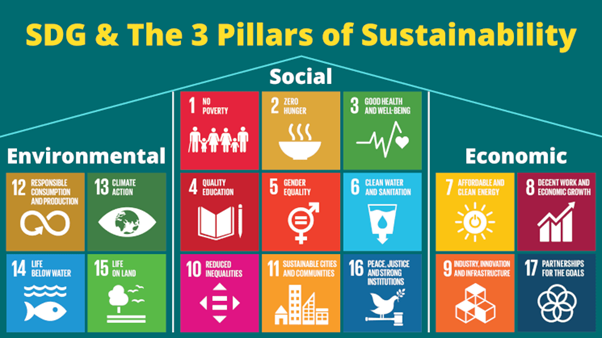
The 17 Sustainable Development Goals (SDGs)
These are the world’s plan to build a better world for people and our planet by 2030. Adopted by all United Nations Member States in 2015, the SDGs are a call for action by all countries – poor, rich and middle-income – to promote prosperity while protecting the environment. They recognize that ending poverty must go together with strategies that build economic growth and address a range of social needs including education, health, equality and job opportunities while tackling climate change and working to preserve our ocean and forests.
Eight Principles that underpin our approach
1. Reduce
- Decrease consumption of food wastage, resources and materials.
2. Reuse/ Repurpose
- Use materials many times and for different purposes.
3. Repair
- Fix things rather than discarding them or repurposing them.
4. Recycle
- Learn about the alternatives to discarding rubbish and educate children about the importance and impact they can have through this.
5. Rot
- Let things go back to the earth to enrich the next crop of plants while also providing a habitat for insects and bugs.
6. Respect
- Nurture understanding and respect of nature and natural processes, showing consideration and compassion for all people and animals.
7. Reflect
- The habit/skill of being thoughtful, asking questions and wondering about experiences.
8. Responsibility
- Being trusted to take care of something or to do something worthwhile
Legal Framework
- Early Years Foundation Stage (EYFS) Framework 2025
- Environmental Protection Act 1990
- Climate Change Act 2008
- Waste Regulations 2011
Further Guidance
Sustainability leadership and climate action plans in education
Sustainability leadership and climate action plans in education - GOV.UK
UN Sustainable Development Goals
United Nations Sustainable Development Goals (SDGs)
West Sussex Climate Change Strategy
Climate Change Strategy - West Sussex County Council